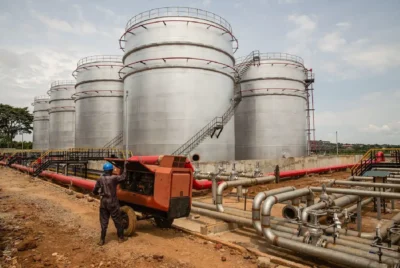

TotalEnergies is leading the development of the East African Crude Oil Pipeline (EACOP) and the Tilenga Oil Field projects. These projects necessarily involve the relocation of Project Affected Persons (PAPs) and disruption to the environment.
TotalEnergies has been accused of multiple mismanagement of PAP relocation process, causing harm to the environment and wildlife during the development of the pipeline and oil fields.
Victims of TotalEnergies’ activities, supported by several international organizations, managed to gather evidence of alleged abuses and have filed cases against Parent Company in France.
The first case, though not filed directly against TotalEnergies, framed the public narrative that TotalEnergies was ignoring communities and prioritizing profit, giving rise to the “ruthless greedy beast” perception.
The African Institute for Energy Governance (AFIEGO) in Uganda and Natural Justice in Kenya sued the Governments of Uganda and Tanzania, which host the East African Crude Oil Pipeline. The plaintiffs accused the pipeline of violating the East African Community (EAC) Treaty by displacing families without adequate compensation and by threatening critical ecosystems. The case was dismissed on a technicality for being filed outside the statutory time limit. However, the publicity surrounding the case caused TotalEnergies significant reputational damage. Although the case was filed against the Ugandan and Tanzanian Governments, public perception placed responsibility on TotalEnergies. The local public view foreign Companies to have unimaginable amounts of money and responsible for the entire compensation process. As a result, this case focused public attention in Uganda and Tanzania on TotalEnergies’ disregard for Project Affected Persons (PAPs). Consequently, many now perceive TotalEnergies as a profit-driven company with little regard for people; greed at the expense of human lives.
This reputation is damaging for a company intending to operate long-term in a country’s most strategic sector.
Beyond scholarships and the construction of health facilities, TotalEnergies must urgently redesign and buttress its livelihood restoration programs to ensure that most PAPs can achieve a decent and sustainable livelihood. Without this, TotalEnergies risks fostering long-term hostility among Ugandan and Tanzanian communities.
Re-engaging PAPs can avoid past experiences faced by French Companies in Africa. For example, in Cameroon, dissatisfied workers of the French SOMDIA group set fire to 150 hectares of the company’s sugar plantation. In West Africa, local communities blockaded SOCFIN’s facilities in response to farmland expansion at their expense.
I recommend Foreign Companies in the extractive or infrastructure development sectors to engage extremely competent subcontractors to deliver resettlement and community programs. Where a subcontractor fails, the work must be redone to satisfaction of affected communities. Communities are aware of the value companies will derive from these projects after relocation. Allocating a reasonable portion of that value to ensure PAPs are secure in their next phase of life is both ethical and strategic.
Following the dismissal in Arusha, in 2023 international NGOs shifted their focus to Total Energies, sued Total energies in the French courts,
In 2023, TotalEnergies was sued by international NGOs and 26 Ugandan communities under France’s 2017 Duty of Vigilance Law. This law requires large French companies to implement a vigilance plan to identify and prevent severe human rights and environmental violations across their global operations, including subsidiaries and subcontractors.
Allegations against TotalEnergies regarding the Tilenga Project were;
- Expropriation of land without adequate compensation;
- Drilling activities within Murchison Falls National Park, threatening endangered species;
- Arrest and torture of individuals who criticized the project.
During hearing, the plaintiffs requested an immediate halt to TotalEnergies’ activities pending the final judgment. TotalEnergies asked the court to reject the emergency suspension until a full trial could determine whether the allegations were substantiated.
The court agreed with TotalEnergies and declined to halt operations. However, in a partial win for the plaintiffs, in 2025 the court ordered TotalEnergies to hand over internal documents relating to land acquisition, compensation, and stakeholder engagement. The purpose is to determine whether TotalEnergies’ compensation met the standard of “adequacy” under both Ugandan law and the French Duty of Vigilance Law.
In response, total energies denied all allegations. It stated that land acquisition was conducted in accordance with Ugandan law, IFC Performance Standards, and its French Vigilance Plan. It further argued that delays were caused by complex local legal disputes and land titling issues, not by corporate negligence.
Key Lessons for Foreign Companies in Uganda’s extractive sectors and Infrastructure development;
A. Sustainable Livelihood Restoration for PAPs
The most critical aspect of PAP management is ensuring that affected persons achieve sustainable livelihood restoration or improvement in their new locations.
Companies must enable PAPs to have a better quality of life after relocation. This requires more than cash compensation. PAPs need capacity building to start and manage income-generating enterprises. A PAP who can sustainably meet their needs is far less likely to complain.
Paying compensation in accordance with the law is not enough. The key question is whether that compensation achieves its intended purpose. Without support to invest compensation productively, the objective of restoration is not met.
B. Government Coordination and Timelines
Companies should engage the Government of Uganda proactively to ensure the timely issuance of necessary operational permits. Delays make effective and orderly relocation within a limited timeframe extremely difficult.
While the Constitution mandates the Government to compensate PAPs, bureaucratic inefficiencies often cause delays. Companies should negotiate to place a company delegate on the Government compensation team. This delegate can work alongside government officials to ensure compensation is processed according to agreed schedules and commitments made to PAPs.
C. Legal Expertise in Resettlement Teams
Companies should ensure that Resettlement Action Plan (RAP) implementing teams include a sufficient number of lawyers. Most current RAP consultancies are dominated by environmentalists and social scientists. Yet the most complex challenges during relocation are legal in nature.
Lawyers are essential for processing documents such as certificates of title and letters of administration, which often cause major delays. They are also best placed to design and oversee mechanisms for speedy local dispute resolution.
D. Human Rights and the Use of Security Forces
Companies must avoid reliance on government security forces to protect operations or facilitate project activities. A company cannot credibly distance itself from the actions of state security if those actions were undertaken for the company’s benefit and the company gained from them.
Many extractive and infrastructure companies do not include clauses in their agreements with Government that explicitly prohibit the use of state security for project implementation. Such a clause should be included in all engagement documents with Government, and reinforced by clear internal company policy. The company’s position on this matter must be communicated to government from the outset.
E. Parent Company Accountability
TotalEnergies argued for a separation between TotalEnergies SE in France and TotalEnergies EP Uganda. However, French, UK, and US courts are increasingly rejecting this defense. Parent companies are being held liable for violations committed by their foreign subsidiaries and branches.
Recent examples include;
- Lafarge, France 2026; Found guilty in a French court for human rights violations by its Syrian subsidiary.
- Vedanta, UK: Successfully sued in the UK for environmental violations by its Zambian subsidiary, KCM.
- Glencore, US: Successfully sued for corruption and bribery by its foreign subsidiaries.
Foreign parent companies must actively participate in policy formulation and oversight for their subsidiaries and branches. Courts and communities no longer accept the argument that the parent and subsidiary are entirely separate.
By addressing PAP relocation and livelihood restoration mismanagement, preservation of the environment, avoidance of use of Government security, and active participation in subsidiary or branch’s activities, foreign Companies can reduce legal risk, protect their reputation, and secure a long-term social license to operate in Uganda.
Kikomeko Muhammad
Howard University School of Law
Partner KM Advocates & Associates.